
Dignity by Design
India's women's free transit schemes serve 50 million women every day. What if technology could make a great policy even greater?
women's free transit
The Achievement
A policy revolution that moved millions of women.
Something remarkable happened in Indian public transport over the last three years. Across six states, governments decided that women should ride buses for free. Not subsidised. Not discounted. Free. The result has been transformative — millions of women who previously walked, waited, or simply stayed home are now riding buses to work, to college, to hospitals, to temples, to visit family.
In Karnataka alone, more than 75 lakh women board state-run buses every single day under the Shakti Yojana. In two years (June 2023 to June 2025), the scheme recorded over 474 crore free journeys. By October 2025, the number had crossed 564 crore — certified by the London Book of World Records as the largest number of free bus rides for women anywhere in the world. By early 2026, it was reportedly crossing 660 crore.
An Azim Premji University study analysing 2.89 crore BMTC trips found that women's daily ridership in Bengaluru rose 151% — from 5.06 lakh to 12.72 lakh per day. Women went from 40% of passengers to 62%. Transport Minister Ramalinga Reddy cited a 23% rise in women's employment in Bengaluru, attributing it directly to the removal of transport costs.

This isn't just a transport policy. The Azim Premji researchers described it as "a gendered reorientation of urban space and its economic geographies."2 Women are travelling more — but they're also travelling differently. Routes through Bengaluru's Central Business District (Majestic, KR Market, Shivajinagar) show the highest share of Shakti riders. Women are accessing jobs, education, and healthcare that were previously beyond reach.
A Movement Across Six States
Karnataka wasn't the first. Delhi launched the Pink Ticket scheme in 2019, providing paper-based free travel without ID verification. Tamil Nadu followed in 2021. Then Karnataka's Shakti in June 2023 accelerated the movement. Telangana launched Mahalakshmi in December 2023. Andhra Pradesh introduced Stree Shakti in August 2025. Punjab is rolling out smart cards.
Each state brought its own approach, its own scale, its own identity.
Shakti Yojana
India's largest. Covers BMTC, KSRTC, NWKRTC, KKRTC — over 18,000 non-premium buses. Smart card approved February 2026.
Pink Saheli Smart Card
NCMC smart card replacing paper pink tickets. Launched 2 March 2026 by President Murmu. Free on DTC and Cluster buses. Rechargeable for Metro.
Mahalakshmi
Free bus travel for women, girl students, and transgender persons on TSRTC buses. Smart card announced February 2026.
Stree Shakti
Free travel on APSRTC non-premium buses. Requires original Aadhaar with AP address. Over 12,000 buses.
Free Bus Travel
Operational since 2021. Minimal verification — no formal ID on ordinary buses. CAG-audited.
Smart Card Transition
Dept of Social Security leading rollout integrated with welfare databases.
Add it all up: India now has an estimated 5+ crore women riding state-run buses for free every day. Over a thousand crore transactions annually. Combined state reimbursements exceeding ₹10,000 crore a year. No country has attempted gender-targeted transport subsidies at this scale.
The policy achievement is undeniable. The question this article asks is not whether these schemes are working — they clearly are. The question is: what if technology could make them work even better?
Every one of these schemes is navigating a common challenge: how to verify eligibility at scale, quickly, without creating friction at the point of boarding. Technology offers a path — not to replace what's working, but to enhance it. To make it faster, more dignified, more data-rich, and more sustainable.
The Dignity Dividend
What changes when a woman holds a card instead of showing an ID.
Consider what happens today. A woman boards a bus. She reaches for her Aadhaar card. The conductor inspects it — is the address local? Is the photo recognisable? Is this the original or a photocopy? The process takes 15-30 seconds. Multiply that by 50 women at a busy terminus like Majestic, and you have 12-25 minutes of verification time — before the bus moves an inch.
But the time isn't the real cost. The real cost is what happens in those seconds. The conductor is overworked — managing tickets, schedules, safety, and now identity verification, all at once. The woman is in a queue, holding out her document, waiting for approval. Other passengers watch. Sometimes they comment. The verification process, however briefly, transforms a statutory right into something that must be requested, inspected, and granted.
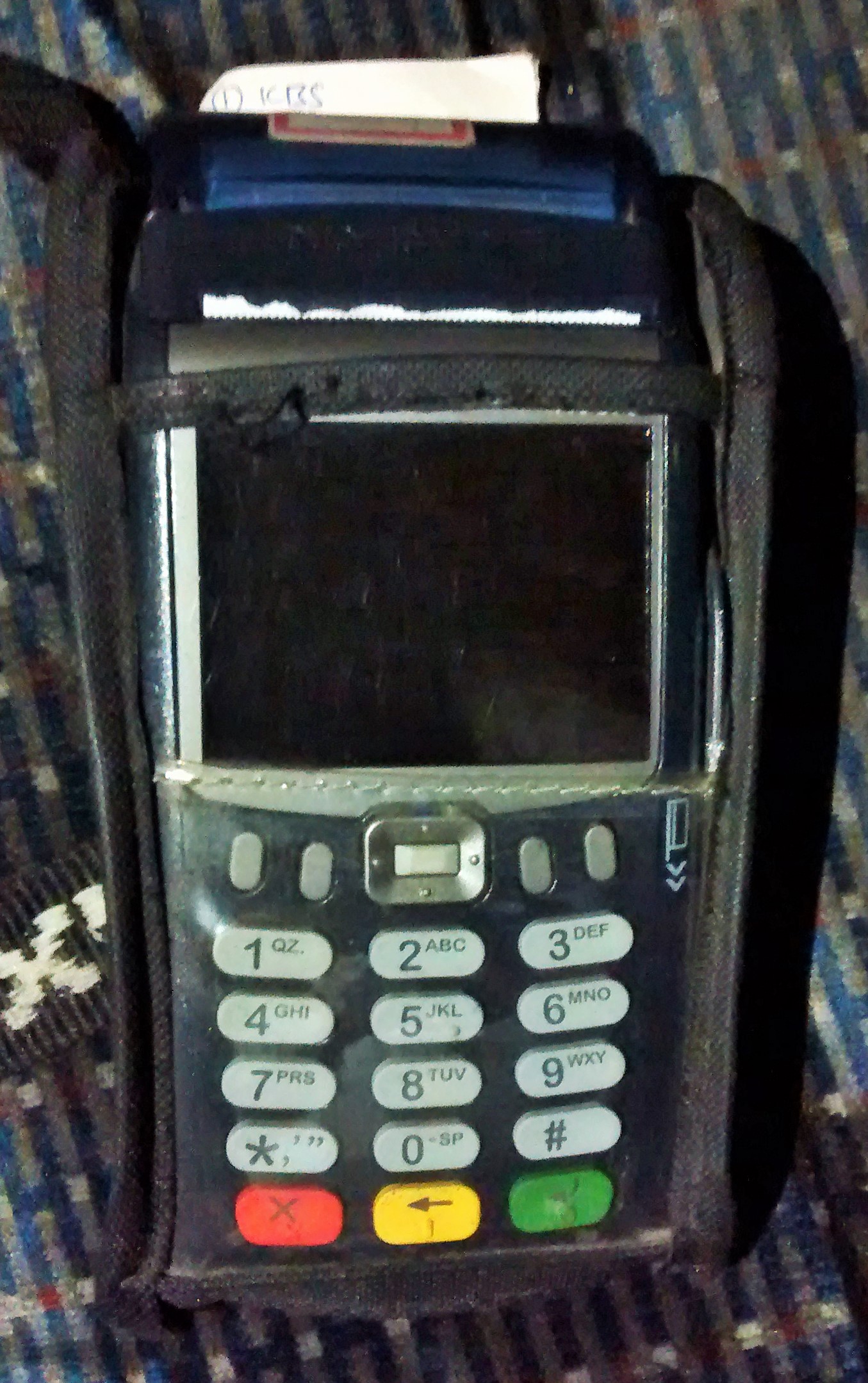
Conductors across India deserve recognition for what they manage daily. They're handling millions of verification requests with limited tools, limited training, and limited time. The opportunity isn't about finding fault. It's about giving everyone — the woman, the conductor, the transport corporation — better tools.
Now Imagine This
A woman walks up to a kiosk at the bus depot. She places her finger on the biometric scanner. Aadhaar authenticates in seconds. A card emerges — distinctively designed, visibly pink, branded with the scheme name, her photo printed on it. NCMC-compliant. Ready to use.
She boards the bus. The conductor sees the card from a distance — the colour, the design, the branding are unmistakable. No questions. No ID shown. No document inspected. She taps. She rides.
The card is the proof. A woman holding a distinctively designed transit card doesn't need to explain herself, show her Aadhaar, or wait for approval. The card — visible, verified at issuance, unmistakable in design — transforms eligibility from something she must repeatedly prove into something she simply possesses.
What Changes for the Woman
She boards without asking. Without explaining. Without waiting for someone else to decide. The card in her hand is hers — issued once, used daily, a tangible credential of her entitlement. She no longer needs to carry her Aadhaar separately. She no longer worries about whether the conductor will accept a digital copy or demand the original. The card is the original.
What Changes for the Conductor
Fifteen to thirty seconds per verification, gone. A visual check of a distinctive card replaces document inspection. The conductor's role returns to what it should be — managing the bus, ensuring safety, keeping to schedule. The verification burden lifts. The conflict potential drops. The job becomes more manageable.
What Changes for the Transport Corporation
Every tap on that card generates a data point — who rode, which route, what time, which station, how frequently. Instead of aggregate "zero-ticket" counts, the corporation now has individual journey records. This data transforms operations. But we'll get to that in the next section.

The Issuance Challenge
Every state that has announced smart cards faces the same bottleneck: issuance. Karnataka approved Shakti smart cards in February 2026 — nearly three years after the scheme launched.4 Delhi's Pink Saheli launched with 50 centres issuing roughly 40-45 cards each on day one.5 At that rate, covering Delhi's 10+ lakh daily beneficiaries would take years.
The gap isn't technology. The gap is infrastructure. Centralised issuance — portal applications, centre visits, postal delivery — replicates the access barriers that the free transit policy was designed to overcome. A woman who can't afford to miss a day's wages to visit a centre during 9-5 hours is exactly the woman the scheme exists to serve.
What if every major bus depot had a self-service kiosk? What if a woman could walk up, authenticate with Aadhaar biometric, and walk away with a card in under 60 seconds? What if the kiosk operated 24/7 — available when she arrives for her morning bus, not just when a government office is open?
The technology for this exists. It's not speculative. Full-KYC NCMC card issuance in 45 seconds has been demonstrated at Bengaluru Namma Metro — operational, at scale, with 99.9% uptime.6 Bus depot deployment is a natural extension — same hardware capability, different location.
Distributed self-service kiosks at bus depots could transform card issuance from a multi-step, multi-day process into a walk-up, 60-second experience. The kiosk operates 24/7. The woman authenticates with Aadhaar biometric. The card is personalised, printed, and dispensed on the spot. No portal. No waiting. No return visit.
The Data Goldmine
What a full-KYC NCMC card unlocks for the government and the city.
Today, most women's free transit schemes operate on aggregate data. Karnataka knows that 75 lakh zero-tickets were issued today. But it doesn't know which women rode, on which routes, at what times, how frequently, or where they got on and off. The reimbursement to transport corporations is based on estimation and negotiation — not on verified, individual transaction records.
A full-KYC NCMC card changes everything. Every tap generates a timestamped, route-identified, passenger-linked data point. The woman remains the same — she boards, she rides, she goes about her day. But behind the scenes, a picture emerges that has never existed before in Indian public transport.
The Chairman's Dashboard
Imagine this on the screen of a BMTC or KSRTC chairman:
Route Intelligence
Which routes have the highest women's ridership? Where is demand exceeding capacity? Where should new services be added? Real-time, not estimated.
Fleet Optimisation
If 12,000 women ride the Electronic City corridor every morning between 7-9 AM, deploy more buses then. Data replaces guesswork.
Travel Time Insights
How long are journeys actually taking? If Majestic to Electronic City takes 90 minutes instead of 60, the data reveals where the bottlenecks are — and where roads need attention.
Reimbursement Precision
Daily transaction data transmitted to state treasuries. Automated reconciliation. No more estimation-based negotiation. Auditable, transparent, real-time.
Fraud Prevention
Aadhaar-linked cards eliminate duplicates. Cross-scheme detection prevents multiple registrations. Real-time authentication replaces visual inspection.
Urban Planning
Where are women travelling from? Where are they going? The government gains a living map of women's mobility — invaluable for infrastructure, safety, and economic planning.
Data Monetisation Revenue
Anonymised mobility profiles become a monetisable asset. Microfinance institutions, insurers, skilling programmes, and retailers will pay for verified women's commute and employment zone data. The transport corporation earns revenue from the data its subsidy generates — a live ticker of data-driven income streams that didn't exist before the card.
Subsidy Cost Reduction
Duplicate elimination, fraud prevention, and precise reimbursement arithmetic reduce the effective cost of the subsidy. Predictive fleet scheduling cuts dead kilometres. Route rationalisation lowers per-trip operating costs. The dashboard shows a running estimate of costs avoided — the subsidy shrinking itself through the intelligence it creates.
This isn't hypothetical analytics. This is what every metro system in the world already operates on — individual journey data powering operational decisions. Bus systems, because of their cash-and-ticket heritage, have historically lacked this granularity. Full-KYC NCMC cards leapfrog the bus system into the same data universe that metro systems occupy.
From Estimation to Evidence
Consider the reimbursement problem. Today, Karnataka's transport corporations report aggregate zero-ticket counts, and the state treasury reimburses based on estimated distance and negotiated rates. Over two years, the notional ticket value of free rides reached ₹11,994 crore — reimbursed by the state government to the four transport corporations. But how accurate are the estimates? Without individual journey data, neither the government nor the corporation can verify the actual quantum of travel.
Card-based tap data settles this definitively. Every journey has a boarding point, an alighting point (where infrastructure permits), a timestamp, and a passenger identity. Reimbursement becomes a matter of arithmetic, not negotiation. The CAG gets auditable records. The treasury gets daily settlement capability. The transport corporation gets faster cash flow.
Road Planning and Infrastructure
Here's a dimension that no one is talking about yet. If the government knows that a particular route — say, Majestic to Whitefield — consistently takes 40% longer than the scheduled time, it's not just a bus problem. It's a road problem. The data reveals traffic bottlenecks, road surface issues, signal timing inefficiencies — all visible through the travel time patterns of millions of daily journeys.
A transport corporation chairman looking at this data can make a case for road improvements, signal optimisation, or dedicated bus lanes — backed by hard evidence, not anecdote. The data from women's transit cards becomes an input into the city's infrastructure planning process.
The data value proposition for the government is enormous. Route optimisation. Fleet deployment. Reimbursement precision. Fraud prevention. Urban planning. Road infrastructure. Employment mapping. Safety analysis. All from a card that costs ₹50-80 to issue and saves the woman from showing her Aadhaar every single day.
A Subsidy That Pays for Itself
There's a deeper idea here that deserves attention. We tend to think of social subsidies as costs — money out, benefit delivered, line item closed. But what if a subsidy could generate an asset so valuable that it more than pays for itself?
Consider what full-KYC NCMC data from 75 lakh daily women riders actually represents. It's a living, breathing dataset of verified women's economic activity — where they travel, how often, what times, which corridors, which employment zones, which commercial areas. Timestamped. Aadhaar-linked. Updated twice a day, every working day.
This data has value — not just for the transport corporation, but for the entire ecosystem:
- For MFIs and lenders: Travel regularity is a proxy for employment stability. A woman who rides the same route 250 days a year is creditworthy — and now you have the data to prove it.
- For insurance companies: Route patterns reveal risk profiles, health corridor access, and family coverage gaps.
- For marketers and retailers: Anonymised, aggregated corridor data shows where verified women with known income bands are spending their time — every morning and every evening.
- For urban planners: Women's mobility patterns are a direct input into safety infrastructure, lighting, last-mile connectivity, and commercial zone development.
- For the government itself: Scheme effectiveness measured in real-time. Did the free bus ride actually increase women's access to employment zones? The data answers this definitively.
We at Frog8 believe that even social subsidies should pay for themselves. The data that this card creates is worth its weight in gold. This is not just a free ride — it's a dataset that can be monetised by the government, by MFIs, by lenders, by insurers, by marketers. Think of it as another CIBIL score — but built from mobility, not credit history. The subsidy funds itself.
— Vinayak Prasad, Founder, Frog8 Technology Services
This reframes the entire conversation. A state government evaluating whether to fund smart card issuance infrastructure isn't just buying kiosks and cards. It's building a data asset — a verified, full-KYC, daily-updated dataset of women's economic mobility that has commercial and policy value far exceeding the cost of issuance.
The ₹50-80 card becomes an investment, not an expense. The kiosk at the bus depot becomes a data collection point, not just an issuance point. The subsidy generates returns — in better planning, in fraud reduction, in commercial data value, and in evidence-based policy that the government can use to justify and optimise every rupee spent.
The Platform Vision
One card. Every service. Beyond transit.
An NCMC card is not just a bus pass. NCMC — the National Common Mobility Card — was designed by NPCI and RBI as an interoperable platform. The same card that taps at a bus can tap at a metro gate, pay at a retail merchant, and — crucially — receive government benefit transfers.
This is where the story gets much bigger than transit.
Beyond Free Rides
India has dozens of government schemes that transfer benefits to women — scholarships, pension payments, healthcare subsidies, cooking gas subsidies, maternity benefits, widow pensions, disability allowances. Today, these flow through bank accounts, often requiring separate KYC, separate documentation, separate verification for each scheme.
What if the same card that gives a woman free bus rides also became her channel for receiving other government benefits? The full-KYC has already been done — at the bus depot kiosk, in 60 seconds. The Aadhaar is linked. The bank account is connected (NCMC cards are linked to savings accounts). The identity is verified.
One card. One identity. One verification. Every government scheme she's entitled to — flowing through a card she already carries, already uses daily, already trusts.
The card becomes a platform. It starts as a bus pass. It becomes a payment instrument. It becomes a benefit transfer channel. It becomes a city credential. Each additional use makes it more valuable — and less likely to be abandoned or lost.
The Positive Spiral
Think about what happens when the card accumulates uses:
Day 1: Free Bus Ride
The woman receives her card at the bus depot kiosk. She taps and rides. The card is a bus pass.
Week 1: Metro Too
The same NCMC card works at metro gates. She recharges it for metro travel. One card, two transit systems.
Month 1: Retail Payments
RuPay NCMC cards work at 5+ million merchant terminals. She taps to pay for groceries, pharmacy, coffee. The card is a wallet.
Month 3: Government Benefits
Her scholarship credit, her pension, her maternity benefit — deposited directly to the account linked to her card. The card is a benefit channel.
Year 1: City Credential
The card is her identity in the city — transport, payments, benefits, services. One credential. Every door.
This isn't fantasy. It's the path that Hong Kong's Octopus card, Tokyo's Suica, Seoul's T-money, and London's Oyster have all followed — starting as transit cards and evolving into city platforms. India has the additional advantage of Aadhaar (instant eKYC), UPI (real-time payments), and NCMC (interoperable standard) — infrastructure that these cities built over decades, available in India today.
What If?
What if every major bus depot in Karnataka — BMTC's terminals in Bengaluru, KSRTC's stations across the state — had a self-service kiosk that issued these cards?
What if a woman could walk up, complete Aadhaar authentication in seconds, and walk away with a card that gives her free bus rides, metro access, retail payments, and government benefit transfers — all from a single 60-second interaction?
What if the card was distinctively designed — pink, branded, instantly recognisable — so that the act of boarding became seamless, dignified, and proud?
What if the transport corporation gained a real-time dashboard of women's mobility — route demand, travel patterns, fleet optimisation data — that transformed how cities plan infrastructure?
What if the government gained auditable, transaction-level reimbursement data that replaced estimation with evidence?
What if all of this was possible with proven technology — kiosk-based, 45-second, full-KYC NCMC card issuance — already operational at India's second-largest metro system?
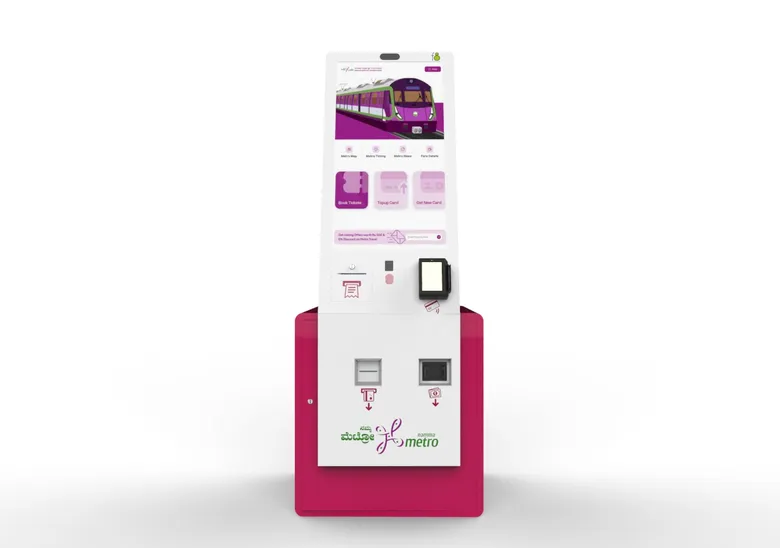
The technology is not the barrier. The policy intent is clear. The scale demands it. The opportunity is to bring these together — proven self-service automation, combined with India's digital public infrastructure (Aadhaar + UPI + NCMC), deployed at the bus depots where women already are.
The result: dignity by design. Not dignity as an afterthought. Not dignity as a slogan. Dignity engineered into the card, the kiosk, the boarding experience, and the data architecture — from the very first tap.
Want to explore this further?
Frog8 builds self-service automation platforms for transit, banking, and beyond. If you're thinking about smart card issuance for your transport network, we'd love to talk.
Get in TouchSources & References
- Karnataka Shakti 2-year data (474.82 crore rides, ₹11,994.37 crore ticket value): The Hindu, "Karnataka's Shakti scheme completes two years," 11 June 2025.
- 564 crore rides, London Book of World Records: Business Today, 15 October 2025.
- 75.68 lakh daily riders: Women Shakti Smart Card Transport Scheme 2026, Karnataka government data as of February 2026.
- Azim Premji University study (151% ridership increase): Azim Premji University, "Gender, Welfare, and Mobility," November 2025.
- 23% rise in women's employment in Bengaluru: Citizen Matters, September 2025.
- Karnataka Shakti Smart Card cabinet approval: Cabinet approved 12 February 2026, ₹200 crore allocation.
- Delhi Pink Saheli Smart Card: Launched 2 March 2026 by President Droupadi Murmu. 50 centres. Day 1: 3,897 cards issued.
- Frog8 TransiGo 4000: 45-second full-KYC NCMC card issuance. Deployed at Bengaluru Namma Metro. 99.9% uptime. PM Modi inaugurated expanded deployment August 2025. frog8.in/deployments.
- Telangana Mahalakshmi: 30+ lakh daily riders. Smart card February 2026, 5 lakh initial target.
- Andhra Pradesh Stree Shakti: Launched 15 August 2025. 2.62 crore target. 12,000+ APSRTC buses.
- Tamil Nadu: CAG audit — 6.5 crore women passengers, ₹1,100 crore reimbursement, 25% revenue loss.
This article is published by Frog8 Technology Services as part of our Insights series exploring how self-service automation can enhance public infrastructure in India. Frog8 builds and operates kiosk platforms for transit, banking, and payments — including full-KYC NCMC card issuance deployed at Bengaluru Namma Metro since April 2024. We believe technology should serve dignity, not just efficiency. Learn more about Frog8 →